© 2026 社團法人國家生技醫療產業策進會 & 財團法人生技醫療科技政策研究中心 版權所有

2021-11-03
Source:China Medical University & Healthcare System
Heart disease has been ranked second among the top ten causes of death in the country. It has always been a common emergency in emergency cases. Among them, ST-segment ascending myocardial infarction (STEMI) is the most common disease. The AI Center of the CMUH cooperate with QT medical and use "Prehospital Remote Auxiliary Diagnosis System for STEMI" and it has already use it in the fire department of Taichung city and Nantou County to assist medical worker to diagnosis the disease and grasp the golden hour of rescue.
Dean Kai Chen, Hsu who is the director of Ai Center for Medical Diagnosis indicate that myocardial infarction is due to coronary arteries is completely blocked and it can easily trigger ventricular fibrillation or ventricular fibrillation and sudden cardiac death such as pulseless ventricular frequency pulse. It can significantly reduce the mortality of the patient by only early perfusion treatment within the golden 12 hours of chest pain.
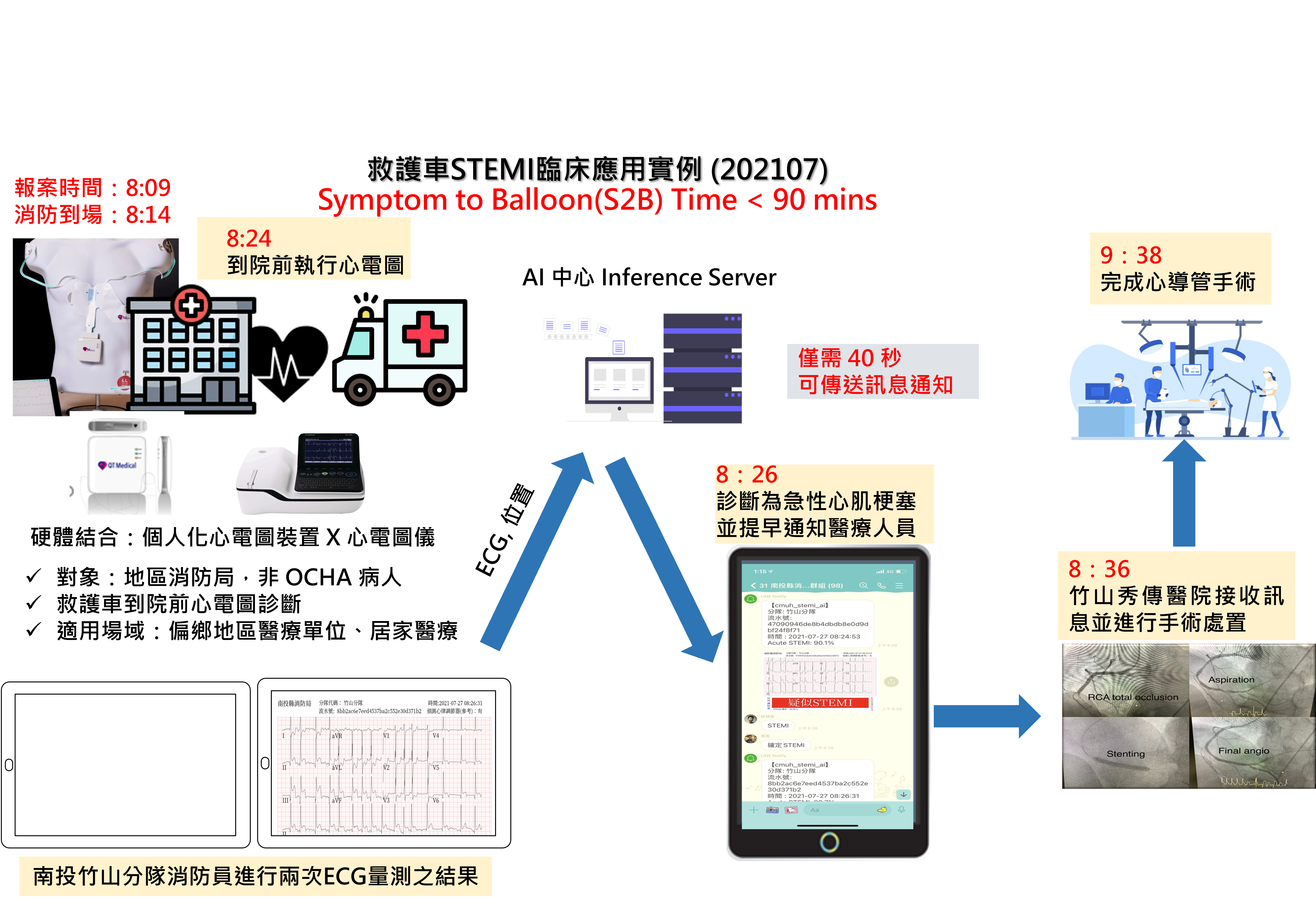
Dean Kai-Cheng Hsu said that AI center has been worked with a team of cardiologists to create an "Artificial Intelligence-Assisted Clinical Decision Support System For Emergency Myocardial Infarction" in 2020, which has been used AI algorithms to analyze the transform in ECG signals and use with the mobile phone's instant messaging mechanism, the time of D2B can be greatly reduced (Door to Balloon: the golden time between the patient's admission to the hospital and the balloon angioplasty). We will cooperate with QT medical in hardware and software further in this year. To combine the portable ECG device PCA 500 developed by QT medical and the artificial intelligence-assisted clinical decision support system for emergency myocardial infarction, we have completed the "Prehospital Remote Auxiliary Diagnosis System for STEMI". It can make EMT rescuers who work in the front line can do STEMI artificial intelligence-assisted diagnosis as soon as they contact the patient, and at the same time transmit the electrocardiogram and auxiliary diagnosis results to the cardiologist's mobile phone for reconfirmation. To avoids the risk of patients who might transfer to another hospital after they arrive in the hospital and to ensure that the STEMI patients who can be taken to a hospital with a cardiac catheterization unit for medical treatment in the first instance.
Dean Kai-Cheng Hsu said that the AI center has officially cooperated with the Fire Department in Taichung and Nantou in July of this year and they apply the STEMI pre-hospital remote auxiliary diagnosis system to emergency rescue work in the front line. According to the statistics of ambulance data from July 17 to September 29 in this year and there were 25 patients who used portable electrocardiograms for emergency care had an average time of 149 seconds to judge whether they were STEMI online, and it only took 39 seconds to use the STEMI prehospital remote auxiliary diagnosis system. Obviously, with the aid of artificial intelligence assistance systems, it has been possible to achieve a reduction from the evolution of D2B time to Symptom to balloon time (the time between the patient's symptoms and the balloon dilation). As the end of September in this year, the STEMI prehospital remote auxiliary diagnosis system has been successfully deployed in the Taichung and Nantou fire stations with a total of 11 teams and assist nearly 50 people with suspected myocardial infarction to seek medical treatment with the STEMI prehospital remote auxiliary diagnosis system. The interpretation results are consistent with the online diagnosis results of cardiologists, and it showed the high accuracy of interpretation of the STEMI prehospital remote auxiliary diagnosis system.